
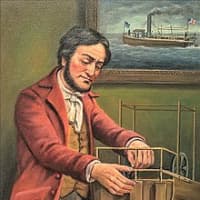
In the restless years before a nation found its footing, along the muddy banks of the Susquehanna and the crowded docks of Philadelphia, there moved a man of restless ambition: John Fitch. Though later remembered for his experiments with steam navigation, Fitch's earlier career unfolded within the uncertain economic landscape of the American Revolution.
The war stretched the resources of the Continental Army to the breaking point. Supply lines faltered under distance, administrative inefficiency, and British disruption, forcing reliance on a patchwork system of state agencies, private contractors, and independent traders. Fitch operated within this world, moving between frontier settlements and urban centers, acquiring goods where he could and selling them where demand proved greatest.
Philadelphia, serving as the political and logistical center of the revolutionary cause for much of the war, provided fertile ground for such enterprise. There, merchants, soldiers, and speculators converged in a constant exchange of goods and information. Fitch's presence in the city placed him within reach of the networks, both formal and informal, that sustained the army.
Among Fitch's commodities, spirits held particular significance. Issued in regulated quantities, it functioned not merely as indulgence but as a vital component of military life, sustaining morale in conditions of cold, hunger, and uncertainty. Fitch's shipments, often secured through indirect and discreet channels, would have been welcomed in encampments where both physical and psychological endurance were continually tested.
Arms procurement proved even more critical. Muskets and powder remained perpetually scarce, drawn from domestic manufacture, foreign imports, battlefield capture, and private exchange. Traders operating beyond official channels frequently filled gaps left by inadequate supply systems.
It is within this context, defined by necessity, improvisation, and quiet negotiation, that one might situate a meeting between Fitch and General George Washington. Washington's correspondence consistently reveals a commander preoccupied with supply, aware that the success of the revolutionary cause often depended on securing even the most basic materials.
One evening in 1778, Fitch is imagined to have been summoned under conditions typical of wartime urgency. Traveling discreetly, he arrived at a modest encampment where Washington reviewed reports by candlelight.
“I am told,” Washington began, his voice measured, “that you are a man who can procure what others cannot.”
Fitch inclined his head. “I deal in what men require, sir.”
Washington regarded him briefly. “My army requires many things. Powder, shot… and at times, a measure of comfort.”
That “measure,” as both men understood, included spirits.
Fitch had secured a shipment, modest but valuable, transported along routes designed to evade British interference. Such supplies, though limited, could steady a regiment, if only briefly.
“And the arms?” Washington asked.
Fitch hesitated. Muskets were harder to obtain and riskier to trade. Some derived from reclaimed British stores; others originated from sources best left unnamed.
“I can supply them,” Fitch replied. “Not in abundance, but enough to matter.”
Washington nodded. The war seldom offered abundance, only necessity.
Their exchange remained brief and practical. There were no grand declarations, only a shared understanding shaped by circumstance. Before Fitch departed, Washington offered a final remark:
See that your dealings favor the cause. History will remember such choices, even if it forgets the men who made them.
Fitch bowed, though history would largely remember him for other pursuits. Years later, as Fitch struggled to perfect his steam-powered vessel and battled creditors and indifference, he would think back to that meeting. To the weight of Washington's gaze. To the knowledge that, for a fleeting moment, his trade (guns and spirits, humble and unremarkable) had played a role in something far larger than himself.
History did, in many ways, forget the details.
But somewhere in the shadows of the Revolution, between supply shortages and small victories, a man named John Fitch helped keep an army moving, one musket, one barrel at a time.
The world in which Fitch lived reflects the documented realities of the Revolutionary War: a world sustained by informal supply networks, reinforced by private enterprise, and held together by the fragile interplay of necessity and resolve. Within that world, a man like John Fitch could indeed play a role, however fleeting, in the larger struggle for independence.
References
- Fischer, David Hackett. Washington's Crossing. (New York: Oxford University Press, 2004).
- Higginbotham, Don. The War of the American Revolution: Military Attitudes, Policies, and Practice, 1763–1789. (New York: Macmillan, 1971).
- Hunter, Louis C. John Fitch: Steamboat Inventor. (Philadelphia: University of Pennsylvania Press, 1935).
- Hunter, Louis C. The Steamboat in America, 1790–1860. (Cambridge, MA: Harvard University Press, 1949).
- “Journals and Papers of John Fitch.” Edited by William T. Hutchinson. (Philadelphia: American Philosophical Society, 1948).
- Lender, Mark Edward, and James Kirby Martin. Drinking in America: A History. (New York: Free Press, 1982).
- The Papers of George Washington. Revolutionary War Series. (Charlottesville: University of Virginia Press, 1985).
- Risch, Erna. Supplying Washington's Army. (Washington, DC: Center of Military History, United States Army, 1981).
- Wright, Robert K., Jr. The Continental Army. (Washington, DC: Center of Military History, United States Army, 1983).