
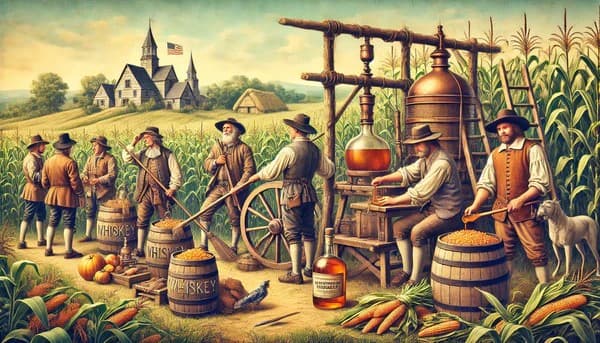
The still had sweated all night. By morning, a thin ribbon of clear spirit dripped into the clay pot at the foot of the worm, slow, patient, inevitable, like the seasons that shaped this corner of Penn's Woods. Ewan McAllister wiped his hands on his breeches and held the pot to the pale October light. Somewhere downriver, Philadelphia was becoming a city. Here, on the limestone-fed creeks of the Cumberland Valley, a man made do with what the land offered, and the land offered grain in abundance.
Ewan had come from Ulster a decade before, one of thousands of Scots-Irish who poured through the port of Philadelphia in the 1720s and 1730s, pushed by rack-rents and failed harvests, pulled by the promise of cheap backcountry land. They brought with them a technology as old as their grievances: the knowledge of distillation, passed down through generations of men who had long ago learned to transform surplus barley and later rye into something that could be stored, traded, and, on the worst nights, endured.
Rye was the crop of the Pennsylvania frontier. Wheat was for the Germans in Lancaster County, who had the flat, rich bottomland and the patience for careful husbandry. Rye asked less of the soil and gave back reliably, even on the rocky hillside plots that newly arrived settlers were often forced to work. And rye, once distilled, became something far more manageable than a wagonload of grain. A farmer could carry a year's surplus down a mountain trail in a pair of jugs.
The distillery Ewan ran was not grand. A stone furnace, a copper pot he had saved for over four years to purchase from a Philadelphia smith, a wooden worm barrel through which cold creek water ran. The science was crude but effective: mash the grain, let it ferment in the open crock, run the wash through the still twice, and the result was a raw, biting spirit that warmed the chest like an ember. Some men added a little charred wood to mellow it. Ewan did not bother. His customers, the traders, the drovers, and the occasional surveyor passing through, were not looking for refinement.
Nor was whiskey merely a vice in this world. It was currency. Pennsylvania had no reliable coinage in the back settlements; transactions were conducted in kind, and rye whiskey, stable and universally desired, served as a medium of exchange as surely as any Spanish dollar. A jug could pay a debt, hire a hand for a week's labor, or purchase a bolt of cloth from a peddler. The taverns that lined the road to Harris's Ferry kept their own accounts partly in spirits, and no one found this remarkable.
The provincial authorities in Philadelphia were not entirely blind to the trade. Excise duties on distilled liquors had been proposed and debated in the colonial assembly, and the question of taxation would grow more contentious with each passing decade. But enforcement in the back counties was a practical impossibility. There were not enough constables, and the men who might have served as informants were themselves likely to have a still hidden behind their barn.
Ewan's thoughts were elsewhere as he drove the cork home and settled the jug into the root cellar's cool darkness, where three others already waited. He thought about the frost that would come this week, the cow that had gone dry, the roof that needed fresh bark before winter. The whiskey was not philosophy; it was logistics.
But outside, the woods were turning, red oak and sugar maple flaring against the grey sky, and somewhere in that transformation was the same patient alchemy that had turned his rye into spirit: raw material, heat, time, and the willingness to wait for what the process would yield. Pennsylvania was still becoming itself. So, in its clay jugs and copper pots, was its whiskey.
References
- Doerflinger, Thomas M. A Vigorous Spirit of Enterprise: Merchants and Economic Development in Revolutionary Philadelphia. Chapel Hill: University of North Carolina Press, 1986.
- Fletcher, Stevenson Whitcomb. Pennsylvania Agriculture and Country Life, 1640–1840. Harrisburg: Pennsylvania Historical and Museum Commission, 1950.
- Leyburn, James G. The Scotch-Irish: A Social History. Chapel Hill: University of North Carolina Press, 1962.
- McCusker, John J. Money and Exchange in Europe and America, 1600–1775: A Handbook. Chapel Hill: University of North Carolina Press, 1978.
- Tachau, Mary K. Bonsteel. "The Whiskey Rebellion in Kentucky: A Forgotten Episode of Civil Disobedience." Journal of the Early Republic 2, no. 3 (1982): 239–259.